CMU 42-633 · Fall 2025 · Individual project
Cross-subject EEG decoding
Predict reaction time and a behavioral trait from short EEG segments while keeping participants separated across data splits.
My role Designed and implemented the modeling pipeline, ran the experiments, and wrote the final course report independently.
The pipeline
The project used the Healthy Brain Network EEG challenge data, with 129 channels and two-second windows, to test generalization to held-out participants.
A frozen EEGNeX encoder feeds a latent adapter. Reconstruction training regularizes the representation, then separate regression heads predict trial-level reaction time and participant-level externalizing traits.
Training and preprocessing keep participant identity as the split boundary. A model should not benefit from seeing another recording of a test participant during training.
What the final score showed
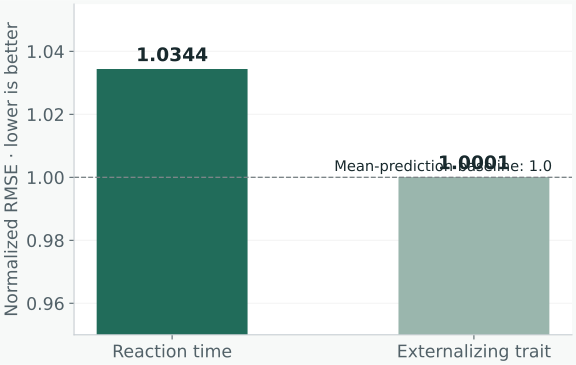
Final normalized root mean squared error (NRMSE) was 1.0344 for reaction time and 1.0001 for the externalizing trait . The mean-prediction reference is 1.0, and lower is better. The final scores therefore did not improve on that reference.
The project demonstrates the full data and experiment pipeline, including a negative result. It does not establish useful behavioral prediction from these short windows. Separating trial-level and participant-level targets was essential to interpreting the evaluation.
Implementation details
Frozen pretrained encoder, residual latent adapter, Gaussian-noise regularization, task-specific regression heads, and a reconstruction objective combining waveform, frequency, and signal-quality terms.
Methods: PyTorch, EEG representation learning, subject-disjoint evaluation, regression, reconstruction regularization.